28mm A & A.... for Impetus.
Sunday, 31 March 2013
Late Roman Light Cavalry
Two units of these guys finished off over Easter.....now for some skirmish foot archers and this army is pretty much ready for the table. Lots of optional add ons still to do but I'll work through those later at my leisure.
28mm A & A.... for Impetus.
Thursday, 21 March 2013
Heraclea: 280BC (The Main Battle)
Epirotes vs Romans
Played out this just recently at the club in Goulburn, with the help of a few others. Stayed over night again as usual and enjoyed some local Thai cuisine on the Saturday night with a few of the guys..... a good bit of nosh the night before battle is a must.
Historical Background:
“While his colleague…, was engaged in Etruria, the consul Publius Laevinus had in the Spring of 280BC again invaded Lucania with the usual consular army of twenty thousand men, and devastated it. Pyrrhus advanced to meet him. On the rolling plain between Heraclea and Pandosia, on the Siris, the Roman Legion first measured its strength against the Grecian Phalanx. Pyrrhus had the slightly superior force. “
“When the king came in sight of the Roman camp, and from across the Siris observed its orderliness…he could not conceal his surprise. He saw that they were not barbarians but a disciplined army to fight, one indeed whose organization was superior to his own. Nor was his surprise quickly lessened; for no sooner did the Romans perceive the approach of the enemy than they filed from their camp with their usual promptness and perfect order, pushed some light troops, sustained by a column of horse through the river ford, smartly attacked the van of Pyrrhus’ army, which was holding the ford, and drove it in on the main body. Startled at this audacious advance and sudden check, Pyrrhus galloped to the front with his three thousand cavalry, and although thrown from his horse, at which for a moment his army was somewhat abashed, soon reestablished the matter along his own front. The Roman van held the fords and enabled the legions to cross, when they deployed into line….”
“The two lines of heavy foot met; the ponderous Phalanx struck its fearful blow, but failed to pierce the legion; it met a foe as it had never encountered. In vain did the sarissa of the Epirots force back the Roman line; as often did the legionaries arrest its onset with their own fierce charge and greater front. The fall, in the fray of Megacles, one of Pyrrhus’ general officers, with whom the king is stated by Plutarch to have exchanged armor-for what purpose is not clear-for the second time threatened the destruction of the phalanx from sheer demoralization at the supposed death of its leader, while the Romans were correspondingly cheered, and Laevinus felt sure of victory; but Pyrrhus, with bared face, rode through the ranks, and to see him revived their courage. The phalanx recovered and once more moved to the attack. The lines clashed again and again. Seven times the Roman charge broke on the phalangial masses…The one could not break the other, nor could this tear its foe asunder…”
“Finally Pyrrhus, unable to make headway, brought to the front his elephants, until now held in reserve. The Roman horse was at this time, seriously, and as Laevinus imagined successfully, threatening Pyrrhus’ flank. Appalled by the aspect of these huge creatures, which none had yet beheld, and which now suddenly appeared behind a roll of ground…the horse fell back in confusion and broke through the line of the legion in its panic. Pyrrhus launched his Thessalian cavalry upon the cohorts, which completed the defeat. The Roman forces fled across the river, but managed to hold the fords against the king’s pursuit, According to Dionysius fifteen thousand Roman legionaries lay dead or wounded upon the field; Hieronymus says seven thousand; two thousand were captured.
Pyrrhus had suffered equally. Dionysius gives thirteen thousand as his casualties; Hieronymus only four thousand killed. But the smaller figure was a terrible loss….Pyrrhus visited the field thus won. He saw that all the dead Romans lay with faces to the foe. “One more such victory and I am lost” quoth he, according to Roman legend.”
(The above was from T.A. Dodge’s 1891 masterwork Hannibal p.110-113)
The Romans and their "orderly" camp
“While his colleague…, was engaged in Etruria, the consul Publius Laevinus had in the Spring of 280BC again invaded Lucania with the usual consular army of twenty thousand men, and devastated it. Pyrrhus advanced to meet him. On the rolling plain between Heraclea and Pandosia, on the Siris, the Roman Legion first measured its strength against the Grecian Phalanx. Pyrrhus had the slightly superior force. “
“When the king came in sight of the Roman camp, and from across the Siris observed its orderliness…he could not conceal his surprise. He saw that they were not barbarians but a disciplined army to fight, one indeed whose organization was superior to his own. Nor was his surprise quickly lessened; for no sooner did the Romans perceive the approach of the enemy than they filed from their camp with their usual promptness and perfect order, pushed some light troops, sustained by a column of horse through the river ford, smartly attacked the van of Pyrrhus’ army, which was holding the ford, and drove it in on the main body. Startled at this audacious advance and sudden check, Pyrrhus galloped to the front with his three thousand cavalry, and although thrown from his horse, at which for a moment his army was somewhat abashed, soon reestablished the matter along his own front. The Roman van held the fords and enabled the legions to cross, when they deployed into line….”
“The two lines of heavy foot met; the ponderous Phalanx struck its fearful blow, but failed to pierce the legion; it met a foe as it had never encountered. In vain did the sarissa of the Epirots force back the Roman line; as often did the legionaries arrest its onset with their own fierce charge and greater front. The fall, in the fray of Megacles, one of Pyrrhus’ general officers, with whom the king is stated by Plutarch to have exchanged armor-for what purpose is not clear-for the second time threatened the destruction of the phalanx from sheer demoralization at the supposed death of its leader, while the Romans were correspondingly cheered, and Laevinus felt sure of victory; but Pyrrhus, with bared face, rode through the ranks, and to see him revived their courage. The phalanx recovered and once more moved to the attack. The lines clashed again and again. Seven times the Roman charge broke on the phalangial masses…The one could not break the other, nor could this tear its foe asunder…”
“Finally Pyrrhus, unable to make headway, brought to the front his elephants, until now held in reserve. The Roman horse was at this time, seriously, and as Laevinus imagined successfully, threatening Pyrrhus’ flank. Appalled by the aspect of these huge creatures, which none had yet beheld, and which now suddenly appeared behind a roll of ground…the horse fell back in confusion and broke through the line of the legion in its panic. Pyrrhus launched his Thessalian cavalry upon the cohorts, which completed the defeat. The Roman forces fled across the river, but managed to hold the fords against the king’s pursuit, According to Dionysius fifteen thousand Roman legionaries lay dead or wounded upon the field; Hieronymus says seven thousand; two thousand were captured.
Pyrrhus had suffered equally. Dionysius gives thirteen thousand as his casualties; Hieronymus only four thousand killed. But the smaller figure was a terrible loss….Pyrrhus visited the field thus won. He saw that all the dead Romans lay with faces to the foe. “One more such victory and I am lost” quoth he, according to Roman legend.”
(The above was from T.A. Dodge’s 1891 masterwork Hannibal p.110-113)
Cavalry Engagement on the Roman left is finely won by them, after first blood going to Pyrrhus.
Pyrrhic phalanx closes in
Some of the elephants manage to get in.......but Pyrrhus and his centre looses momentum falling back and giving way. Pyrrhic centre collapses and it's all over.
This is the map we used for the set up and deployment, once more courtesy of Command and Colours Ancients.
Sunday, 3 March 2013
Isara River - 121BC
It was a wet ol day here yesterday, and a great day for a game..... so my friend Ralph and I re fought ISARA RIVER - 121 BC Gallic vs Roman Middle republican up in the Rhone valley of Germania.
A little background..
The Romans had been campaigning on behalf of their Massiliote allies against the Saluvii tribe of Gauls in the Rhone Valley. When the Saluvii King fled to the Allobroges tribe, the Romans sent an army against them commanded by Gnaeus Domitius. Domitius achieved a stunning victory against the Allobroges at Vindalium in early 121BC. The remains of the Allobroges were then reinforced by the Averni tribe led by their King Bituitus, and the combined army reportedly totalled 180,000 warriors, but looking at similar figures for other Gallic armies a fighting force of 40-50,000 is probably more realistic.
The Romans now sent out a new army of approximately 30,000 men commanded by the Consul Quintus Fabius Maximus.The Gauls and Romans met next to the Rhone river where it is joined by the Isara river from the east. Bituitus, scornful of the Roman numbers, suffered a massive defeat which became even more catastrophic when one of only two bridges he had thrown across the Rhone collapsed under the weight of his routing army.
The Rhone sits at the back of the Gallic army, the river on their left is the Isara.
Looking from the river
Early initial approaches
The centre makes contact first.....crash and the Gauls are getting the better of it.
Romans struggle in the centre having to commit the reserve ( the elephants ). This doesn't go much better for them, and they also get thumped by a war band getting pushed back and looking rather fragile.
Roman right also not going so well.
The Romans kill King Bituitus who is attached to one of the centre war bands. Quintus Fabius Maximus's centre however is done for.
Roman left also breaks in the same turn, leaving what's left of the centre wide open for the Gallic cavalry to sweep around and clean up.
A Gallic victory, but they lost Bituitus......so the bulk of their army also routed.....a very bloody affair. Damn good game !!
This is the map we used for initial deployment, from Command & Colours.
Thursday, 28 February 2013
Roman Generals
These guys will be for my on going Late Roman project......commander in chief and a subordinate commander. Figs are all 28mm A & A .
Friday, 1 February 2013
Roman Clibinarii
Latest unit of heavy cavalry for my 3rd C Romans, and probably the last for the moment as I need to concentrate on getting some light support troops up and running now....... 28mm A&A for Impetus.
Monday, 17 December 2012
Scorpions
Two scorpions finished off for my Romans, probably the last minis for the year what with Christmas bearing down upon us. These are Gripping Beast figs btw.
Friday, 23 November 2012
Basing the little fellas
A few people have asked me about my basing, so I thought I would do a step by step guide. If I miss something I apologise, please feel free to ask if I have or if somethings not clear.
These are the two units of 28mm Cataphracts just completed for my Late Roman Impetus army.
Bases are 120mm x 80mm 3mm ply supplied by Litko.
Figures are first glued down with PVA and left to dry ( sometimes over night )
PVA is then applied with an old nylon brush.....straight, not watered down. I use it quiet liberally as well.
I use a mix of different grades of textured 'grit'.....starting with beach sand ( this is good because there's all sorts of irregular size bits n pieces in there ) and a little model railway ballast all mixed in together. This is the core basing material.
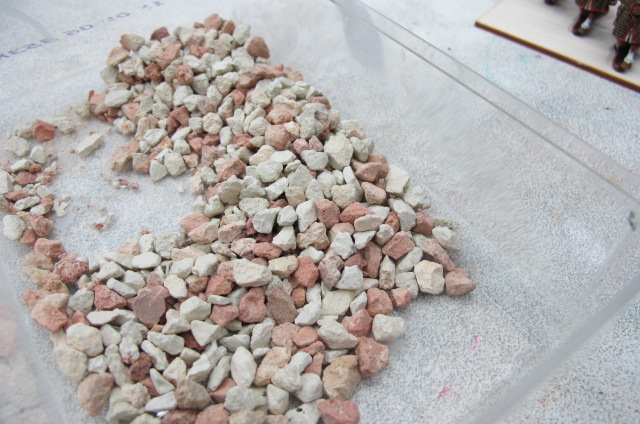
Pet litter is the other added extra, but used sparingly for this purpose.
This bag has lasted years, and is good for making all sorts of terrain features. Very versatile stuff, and cost effective.
Base is then immersed in sand and much of the excess carefully tipped/tapped off. ( I use a craft beading tray for this as it has a nice little hole in one end to pour back into your storage container )
Units were then left over night to dry. ( I also clamp my bases to the table top while drying to stop any warping ). Small clamps from the $2 shop are good enough for this. Spring or h clamps will do the trick.
Once dry brush off excess.
Next is the base coat. Jo Sonja craft paint is my weapon of choice- Provincial Beige. Vallejo - Cork is roughly the same colour.
Paint needs to be watered down, about 50/50. It needs to be thin enough to make it easy to apply but thick enough to cover and stabilise the sand, bedding down your basing material. It'll take some practice to get it just right but when you do you'll know what I'm talking about.
Once again I leave overnight to dry, but you could get away with 2-3 hrs if you were in a hurry.
Dry brushing is next, starting with a mix of the base colour and a lighter shade Jo Sonja - skin tone is what I use.
First highlight at 50/50
Second highlight straight -skin tone
Now for some flocking, I use the fine green ground foam from model railway suppliers.....the shade is up to you, I go for a more olive green than a brighter spring green but it's up to you what you prefer.
I try and make this as irregular as possible and not too much I feel is better, but once again up to you. Applied with straight PVA.
Carefully tap off excess and allow to dry before going on to the next step is preferred but not essential.
Tufts of grass is next, lots of brands out there and many shades. I like to use a mix of seasons for variety. Flowers are also an option here for those in tune with their feminine side : )
They come ready to go.....but I use a little drop of Tarzans grip to make sure they don't come off......ever.
I also like to paint the edges of my bases, light olive green......but that's just me.
Their ready to rock n roll.
Hope this helps chaps, and you get something out of it.
Cheers
Richard.
Subscribe to:
Posts (Atom)